High-sensitivity C-reactive protein (hsCRP) can tell you that inflammation is present. It cannot tell you what is inflamed or why. Oxidized phospholipids (OxPL) offer a narrower molecular clue, and the distinction may matter more than we thought.
Imagine a smoke detector going off in your house.
It tells you something is burning. Useful information. However, it cannot tell you whether the smoke is coming from a toaster in the kitchen, a candle in the bedroom, or a wildfire five kilometers away. In clinical practice, hsCRP works a little like that smoke detector.
hsCRP is an acute-phase protein produced mainly by the liver in response to inflammatory signaling. When it is elevated, it tells us that inflammatory biology is active somewhere in the body. It cannot tell us where the inflammation comes from. An infection can raise it. So can arthritis, tissue injury, excess adiposity, and many other inflammatory states. Importantly, so can cardiovascular disease.
That does not make hsCRP a bad biomarker. Quite the opposite: decades of evidence show that it carries meaningful cardiovascular risk information. However, it leaves a more interesting question unanswered:
What if the inflammation we care about is not simply “inflammation”, but a particular molecular process occurring around atherogenic lipoproteins?
That is where oxidized phospholipids (OxPL) enter the story.
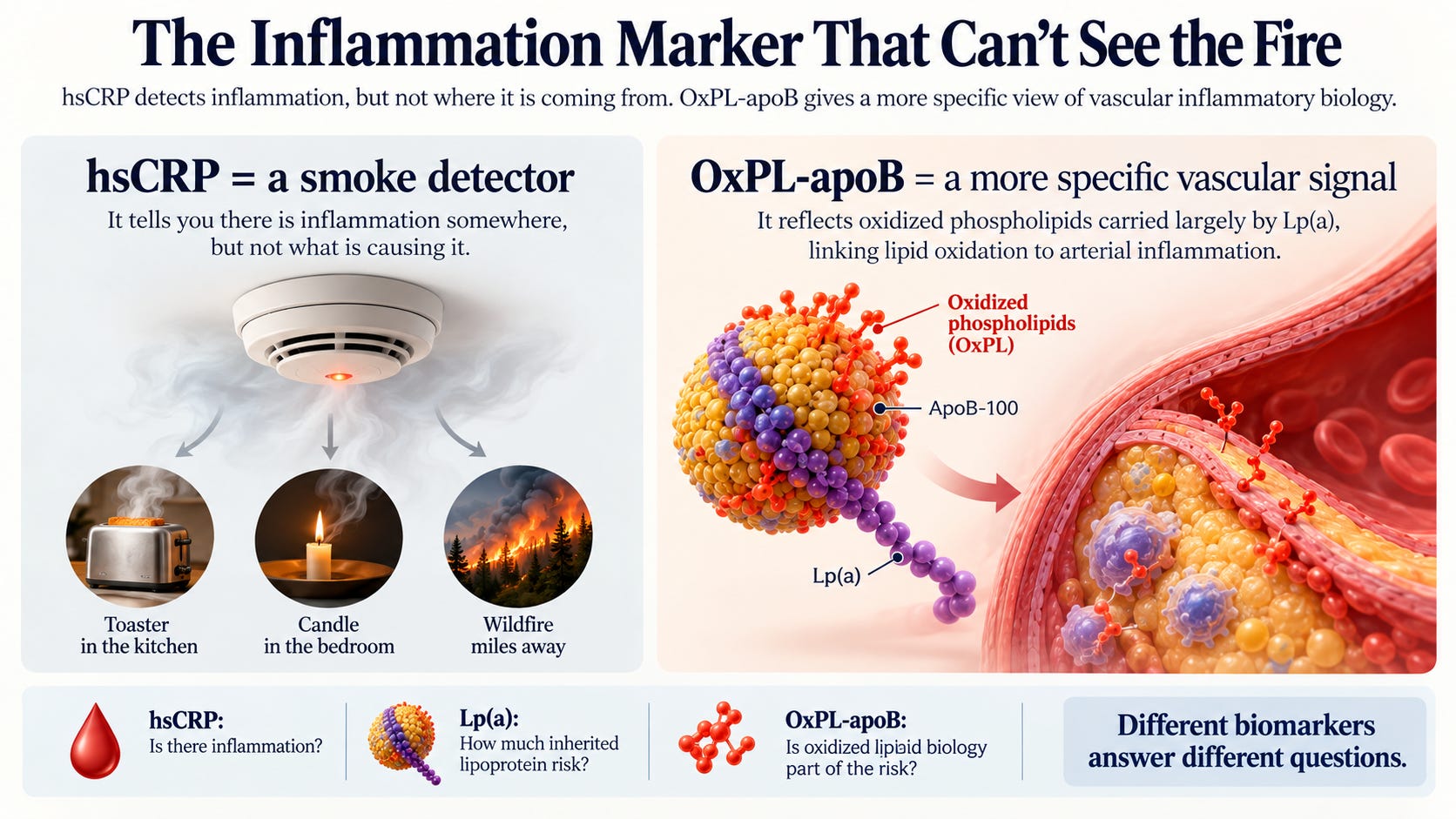
hsCRP and OxPL-apoB capture different layers of inflammatory biology. Illustration generated with ChatGPT.
When a normal lipid becomes a danger signal
Phospholipids are ordinary components of biological membranes and lipoproteins. Oxidize them, however, and their biology changes. OxPL can display molecular structures known as oxidation-specific epitopes. The innate immune system recognizes these altered structures as signs of cellular damage. In immunological language, OxPL can function as damage-associated molecular patterns, or DAMPs.
That distinction matters.
DAMPS are not microbes. They are molecules generated from our own tissues that have been modified in ways that signal damage or danger. Innate immune pattern-recognition receptors bind these oxidation-specific structures directly, promoting pro-inflammatory signaling regardless of the underlying etiology of lipid peroxidation. Pattern-recognition systems, including scavenger receptors such as CD36 and signalling pathways involving Toll-like receptors, can respond to these oxidation-specific structures by promoting inflammatory activity.
In an artery already accumulating lipoproteins, this creates an important biological link:
Lipid retention → lipid oxidation → innate immune recognition → inflammation
The chemistry of a lipid particle has become an immunological signal. That is substantially more specific than simply knowing that hsCRP is elevated.
Meet the particle carrying much of the cargo
OxPLs do not travel through blood by themselves. Among apoB-containing lipoproteins, one particle is particularly important, that is lipoprotein(a), or Lp(a). Lp(a) resembles a low-density lipoprotein (LDL) particle, but with an additional apolipoprotein(a) molecule attached to its apoB-containing core. That structural difference is not cosmetic. Lp(a) carries a particularly large proportion of the OxPL found on circulating apoB-containing particles1.
One way to visualize the difference is this: LDL is a delivery vehicle. Lp(a) is a delivery vehicle carrying additional molecular cargo. Some of that cargo is biologically active. Genetics adds another layer to the story. Unlike LDL cholesterol, which can change substantially with diet and pharmacological treatment, circulating Lp(a) concentration is largely determined by variation in the LPA gene. Two people can therefore have similar LDL cholesterol concentrations, similar lifestyles, and very different lifelong exposure to Lp(a).
The cardiovascular implications appear to be substantial. A genetic analysis comparing Lp(a) and LDL on a particle-for-particle basis estimated that Lp(a) was approximately 6.6 times more atherogenic than LDL, a disparity largely driven by its covalent and non-covalent enrichment with OxPL1,2. However, that number is a genetic risk estimate rather than a literal measure of toxicity for an individual particle.
That finding immediately raises another question.
Why?
Particle number alone may not tell the whole story. The OxPL cargo is one candidate.
An antibody that recognizes oxidation
This is where the OxPL-apoB assay becomes interesting. The assay uses an antibody called E06, which recognizes phosphocholine-containing epitopes exposed on certain OxPL but not on their unoxidized counterparts1. In practical terms, the assay asks:
How much oxidation-specific phospholipid signal is present on a normalized number of apoB-containing particles?
Because of the way the measurement is constructed, the signal is not simply another readout of LDL cholesterol or total apoB. Since much of the measured OxPL-apoB signal tracks with Lp(a), the assay provides information about a particularly inflammatory dimension of Lp(a)-associated biology. That is, it provides a circulating molecular fingerprint of oxidation-specific epitopes carried by atherogenic particles.
Does the signal predict anything that matters?
A mechanistically elegant biomarker is not automatically a clinically useful one. The harder question is whether it tracks with disease. OxPL-apoB has accumulated evidence across several different kinds of studies.
In the Bruneck study, 765 adults from the general population were followed for 15 years. Higher OxPL-apoB was associated with subsequent cardiovascular disease and ischemic stroke, and adding the marker improved risk reclassification, particularly among people whose risk was initially intermediate3. In CASABLANCA, a contemporary cohort of 1,098 patients referred for coronary angiography, OxPL-apoB was associated with the extent of coronary artery disease and subsequent cardiovascular events4. Large clinical-trial datasets have added another layer. In an analysis of 11,630 participants from ODYSSEY OUTCOMES, higher baseline OxPL-apoB predicted major cardiovascular events among placebo-treated patients after acute coronary syndrome. Alirocumab reduced both Lp(a) and OxPL-apoB, although the relationships among Lp(a), OxPL-apoB, treatment, and outcomes were more complex than simple “lower is always better” model5. Histological studies provide complementary evidence. OxPL and apo(a) accumulate in advanced atherosclerotic lesions and are prominent in vulnerable and ruptured plaques1. Together, however, they connect the same signal across several scales:
Molecular mechanism → arterial pathology → circulating biomarker →
cardiovascular outcomes
This integrated evidence chain connects molecular oxidation directly to vascular pathology and prospective clinical event prediction.
And hsCRP?
This is where comparisons can become misleading. The interesting conclusion is not that OxPL-apoB succeeds where hsCRP fails. They are asking different biological questions.
Consider the Women’s Health Study. Nearly 28,000 initially healthy, primary-prevention cohort of women were followed for three decades. Baseline hsCRP, LDL cholesterol, and Lp(a) each independently predicted future cardiovascular events. Women in the highest hsCRP quintile had a 70% higher adjusted risk of the primary cardiovascular endpoint than women in the lowest quintile6. This demonstrates robust predictive power. However, hsCRP measures something broad: the systemic inflammatory state. OxPL-apoB interrogates something narrower: oxidation-specific epitopes on apoB-containing lipoproteins.
You can suppress one signal without moving the other
In the phase II OCEAN(a)-DOSE trial, patients with established atherosclerotic cardiovascular disease and markedly elevated Lp(a) received olpasiran, an siRNA therapy that suppresses hepatic production of apolipoprotein (a). At the higher doses, olpasiran reduced OxPL-apoB by roughly 90% or more.
This represents a profound pharmacodynamic effect.
Yet hsCRP did not significantly change. Neither did circulating IL-67.
Think about what that means. One treatment dramatically altered a lipoprotein-associated oxidation signal while leaving two conventional markers of systemic inflammation essentially unchanged. The biomarkers were not disagreeing. They were answering different questions. These findings confirm that OxPL-apoB and hsCRP quantify distinct, biologically uncoupled inflammatory pathways.
A provocative clue from colchicine
Another study pushed the question one step further. A biomarker analysis from the LoDoCo2 trial examined 1,777 patients with chronic coronary disease who had been randomized to colchicine or placebo. Overall, colchicine is already known to reduce cardiovascular events in chronic coronary disease. However, investigators asked whether baseline Lp(a) or OxPL levels modified that treatment effect. The most intriguing finding involved OxPL-apoB. Patients in the highest OxPL-apoB tertile appeared to obtain greater cardiovascular benefit from colchicine than those in the lowest tertile, with a statistically significant treatment interaction8.
That finding is fascinating.
It is also important not to overinterpret it. This was a biomarker sub-study, not a prospective trial in which patients were selected for colchicine treatment according to OxPL-apoB. The investigators themselves describe the result as hypothesis-generating and in need of independent validation.
In the end, OxPL-apoB is not yet a validated companion diagnostic for colchicine. However, it raises exactly the kind of question precision medicine is supposed to ask:
Instead of asking only whether inflammation exists, can we identify which inflammatory pathway is carrying the risk?
Then the story became more complicated
Until very recently, the next chapter seemed straightforward. New RNA-targeted therapies could lower Lp(a) dramatically. They also lowered OxPL-apoB. The obvious next question was whether doing so would prevent cardiovascular events.
Then came September 2026.
Novartis announced topline results from the phase III Lp(a)HORIZON trial, which tested the antisense oligonucleotide pelacarsen in patients with established cardiovascular disease and elevated Lp(a). Pelacarsen lowered Lp(a). However, the trial did not meet its primary endpoint for reducing cardiovascular events9.
That is not a footnote. It is exactly the kind of result that forces a field to become more precise.
A single trial result does not erase decades of human genetic evidence linking Lp(a) to cardiovascular disease. It also does not establish that OxPL epitopes are biologically irrelevant. When evaluating full trial datasets, several key variables will prove decisive: treatment magnitude and duration, baseline risk, achieved Lp(a) levels, patient heterogeneity, event composition, and precise relationship between Lp(a) lowering and OxPL biology.
Pelacarsen is not the only test of the hypothesis. The phase III OCEAN(a)-Outcomes study of olpasiran remains ongoing. Science rarely progresses as a simple linear chain:
Mechanism → biomarker → drug → success
More often it progresses as:
Mechanism → signal → prediction → intervention → contradiction → better mechanism
The contradiction is often where the interesting science begins.
What OxPL-apoB can (and cannot) tell us today
OxPL-apoB occupies an unusual position. It has a biologically coherent mechanism. It has prospective human outcome data. It has genetic connections through Lp(a). It responds dramatically to potent Lp(a)-lowering therapy. Yet it remains predominantly a specialized research biomarker rather than a routine clinical test.
Cross-laboratory standardization remains limited. No universally accepted clinical threshold tells a physician, “Above this number, perform this intervention.” And there is not yet definitive evidence that choosing therapy according to OxPL-apoB improves patient outcomes.
That distinction matters.
Risk association is not treatment guidance. Mechanistic plausibility is not clinical utility. A biomarker that changes with a drug is not necessarily a validated surrogate endpoint.
Those boundaries do not weaken the science. They define where the science currently ends. That may be the most useful place to look.
The real lesson is about measurement
This series began with ceramides, lipid molecules largely invisible to the standard cholesterol panel yet capable of carrying information that conventional measurements do not capture. It ends with OxPL, molecular signals largely invisible to a conventional systemic inflammation marker. In neither case is the standard wrong. It is answering the question it was designed to answer.
Your lipid panel asks something like, How much cholesterol is being transported in different classes of lipoproteins?
hsCRP asks, Is there evidence of systemic inflammatory activity?
OxPL-apoB asks another question: Are apoB-containing particles carrying oxidation-specific molecular signals associated with atherogenic and inflammatory biology?
Those are related questions.
They are not interchangeable ones.
That distinction points toward something much larger than any single biomarker. As biological measurement becomes more precise, medicine increasingly faces a choice between measuring how much of something is present and understanding what that molecule is doing.
The next frontier may not simply require more biomarkers.
It may require better questions.
One molecule at a time.
Scientific note: This article cites peer-reviewed evidence, clinical guidelines, and reported professional consensus throughout. Sources are independently verifiable and listed below. Claims about individual tests are scoped to the published literature cited and do not constitute medical advice.
José C Bozelli Jr., PhD, is a scientist, data strategist, and writer exploring what biological measurements can—and cannot—tell us. His work spans biomarkers, omics, data science, and the translation of complex evidence into meaningful decisions.
The content of this article is for informational and educational purposes only and does not constitute medical advice. Consult a qualified healthcare professional before making decisions based on biomarker results.
References
Tsimikas S, Witztum JL. Oxidized phospholipids in cardiovascular disease. Nat Rev Cardiol. 2024;21:170–191. doi:10.1038/s41569-023-00937-4.
Björnson E, et al. Lipoprotein(a) Is Markedly More Atherogenic Than LDL: An Apolipoprotein B-Based Genetic Analysis. J Am Coll Cardiol. 2024;83:385–395. doi:10.1016/j.jacc.2023.10.039.
Tsimikas S, et al. Oxidation-Specific Biomarkers, Prospective 15-Year Cardiovascular and Stroke Outcomes, and Net Reclassification of Cardiovascular Events. J Am Coll Cardiol. 2012;60:2218–2229. doi:10.1016/j.jacc.2012.08.979.
Gilliland TC, et al. Lipoprotein(a), Oxidized Phospholipids, and Coronary Artery Disease Severity and Outcomes. J Am Coll Cardiol. 2023;81:1780–1792. doi:10.1016/j.jacc.2023.02.050.
Tsimikas S, et al. Oxidized Phospholipids, Lipoprotein(a), and Cardiovascular Outcomes After Acute Coronary Syndrome. Circulation. 2025;152:1666–1678. doi:10.1161/CIRCULATIONAHA.125.073855.
Ridker PM, et al. Inflammation, Cholesterol, Lipoprotein(a), and 30-Year Cardiovascular Outcomes in Women. N Engl J Med. 2024;391:2087–2097. doi:10.1056/NEJMoa2405182.
Rosenson RS, et al. Olpasiran, Oxidized Phospholipids, and Systemic Inflammatory Biomarkers: Results From the OCEAN(a)-DOSE Trial. JAMA Cardiology. 2025;10:482–486. doi:10.1001/jamacardio.2024.5433.
Mohammadnia N, et al. The effects of colchicine on lipoprotein(a)- and oxidized phospholipid-associated cardiovascular disease risk. Eur J Prev Cardiol. 2025;32:758–765. doi:10.1093/eurjpc/zwae355.
Novartis. Lp(a)HORIZON Phase III topline results for pelacarsen in patients with elevated Lp(a) and established cardiovascular disease. September 4, 2026.
Author & Editorial Note: This article was conceived, conceptualized, edited, and approved by the author/editor. The synthesis of primary literature, citation verification, and prose refinement were conducted in collaborative partnership with Large Language Model (LLM) AI systems (Claude, ChatGPT, and Gemini Notebook).