Imagine getting a blood test result back and staring at a number — maybe it’s flagged yellow, maybe it isn’t — wondering what it means for you. Not for the average person in whatever study generated the reference range. For you, with your diet, your stress levels, your genetics, your history.
That feeling — of data without enough context to use it — is what this series is about.
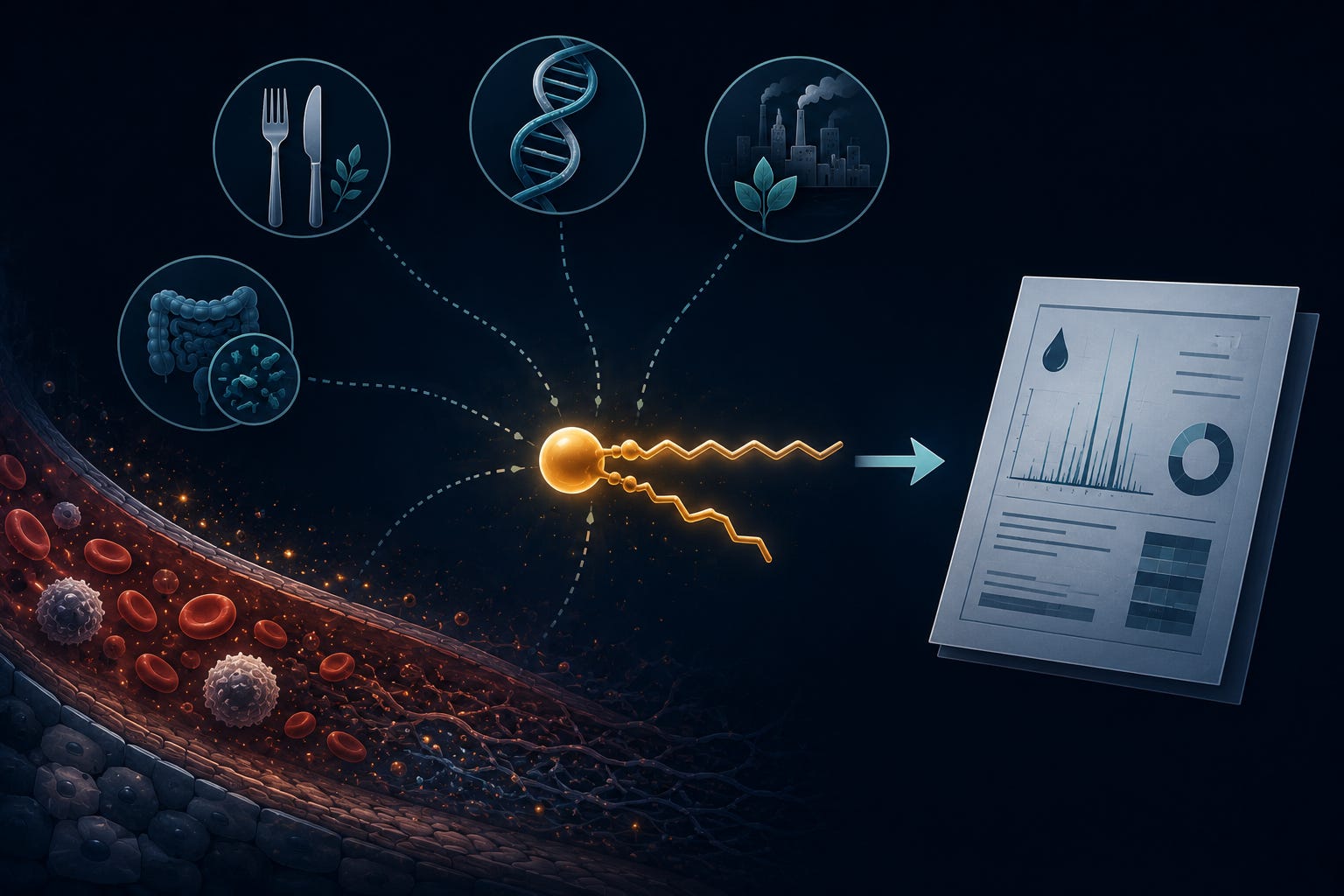
Every molecule in your blood has a biography. Where it comes from. What makes it rise or fall in your specific body, not just in a textbook. What the measurement is capturing, and what it can’t see. Most biomarker content skips that biography entirely and jumps straight from “this molecule is associated with X” to “therefore, measure it and act accordingly.” The gap in between — the biology, the measurement, the evidence, the limits — is where interpretation either holds up or quietly collapses. The goal is to move beyond a simple ‘high’ or ‘low’ flag to understand the physiological state the molecule represents, even where the topic is debated.
This series slows down for that gap, one molecule at a time.
Each article takes one functional readout — a molecule or closely related group — and traces it from origin to interpretation across five beats. We start with the biology — not a dry pathway diagram, but the upstream story of what’s driving the signal. Because what ends up in a blood draw reflects a lot more than a single biological process. Dietary patterns shape it. Inflammatory state shapes it. Gut microbiome activity shapes it. And emerging research shows that genetics can play a subtle but foundational role in shaping these baselines. In studies of British Caucasian families, researchers have found that every signaling lipid measured was significantly heritable, meaning your starting point is partially written in your code before you ever take a bite of food. While specific variants in the enzymes that produce or clear these molecules only account for roughly 3% to 5% of the total variation, they provide a permanent genetic ‘nudge’ to your baseline levels regardless of behavior. ¹ Even long-term environmental exposures — what you’ve breathed, what you’ve been exposed to across a lifetime — can leave a trace in ways the field is still mapping. The number you’re looking at is the output of a system where lifestyle and environment are the primary architects, but genetics provides the underlying blueprint. Understanding the system provides the biological context necessary to interpret why a specific number is present.
Then the measurement: what the assay quantifies, which platform it runs on, and where results can mislead. Then the evidence: what studies have shown, in which populations, with what effect sizes — and what they do and don’t support as a clinical or functional interpretation. And finally, the limits: what a result can honestly tell you about your physiology, and where the field’s knowledge still runs out.
The molecules in this series are chosen by one criterion: the intersection of a functional question people are genuinely asking — about cardiovascular risk, metabolic health, aging, gut function, cognitive resilience — and a body of evidence sufficiently robust to support meaningful interpretation. Where a widely used marker falls short of that standard, we say so explicitly. That’s part of the work too.
Here’s what this series isn’t: a list of things to optimize. The biology is more interesting than that, and more honest. Within-person variation, genetic baseline differences, pre-analytical measurement issues, population-specific effect sizes — all of it matters for what a result means. The goal isn’t to tell you what your number should be. It’s to give you enough of the real story that you can think clearly about what your number is saying.
The bottleneck in modern molecular medicine has never been measurement. It has always been interpretation. We can now detect over a thousand lipid species from a single blood draw. ² Most of what limits their usefulness isn’t the technology — it’s the gap between a number on a page and a genuine understanding of what produced it.
This series is an attempt to close that gap, one molecule at a time.
Coming next: ceramides — the lipid signal beneath your standard cholesterol panel, and the evolving debate over whether these molecules are causal drivers of disease or simply highly sensitive bystanders of cardiometabolic risk.
José Carlos Bozelli Jr., PhD, is a lipid biochemist, omics data scientist, and scientific writer. He advises biotech, CRO, and health-tech teams on lipidomics, large-scale omics data pipelines, and biomarker science — and translates complex molecular data into decisions for scientists, clinicians, and builders.
bozelli.ca
The content of this article is for informational and educational purposes only and does not constitute medical advice. Consult a qualified healthcare professional before making decisions based on biomarker results.
References
¹ McGurk KA, et al. Heritability and family-based GWAS analyses of the N-acyl ethanolamine and ceramide plasma lipidome. Hum Mol Genet. 2021;30(6):500–513. DOI: 10.1093/hmg/ddab002
² Malarvannan M, et al. Transformative potentials, challenges and innovative solutions of lipidomics in multiple clinical applications. Talanta. 2025;291:127855. DOI: 10.1016/j.talanta.2025.127855